




If you live in Jumeirah Village Circle (JVC), you know the specific struggle: one minute you are dusting your living room, and an hour later, a thin layer of fine beige sand has settled again. You also know the feeling of walking upstairs in your townhouse and feeling the temperature rise by 3 degrees compared to the ground floor.
JVC is one of Dubai’s most popular communities, but between the ongoing construction in District 10 through 15 and the unique layout of its townhouses, keeping your AC efficient is a challenge. More importantly, keeping your DEWA bill manageable during the summer months requires more than just turning the dial up.
Whether you are in a Nakheel Townhouse, living in Diamond Views, or settled in Seasons Community, this guide will break down exactly how to maintain your AC, solve the “hot upstairs” problem, and stop wasting money on electricity.
The “JVC Split”: District Cooling vs. Chiller-Free
Before you can lower your bill, you need to know exactly what you are paying for. JVC is unique because it is a patchwork of different cooling systems.
1. District Cooling (Empower)
Many developments in JVC, particularly larger apartment complexes and some townhouse rows (like parts of Seasons Community and Diamond Views), utilize district cooling.
- The Bill: You receive a separate bill from Empower (or another provider) based on “Consumption” and “Demand Charges.”
- The Maintenance Reality: You cannot control the temperature of the chilled water entering your home—that’s Empower’s job. However, you are responsible for the “Fan Coil Unit” (FCU) inside your ceiling.
- Money Saving Tip: If your filters are dirty, the fan has to spin faster to push air through, which doesn’t increase your Empower bill much, but drastically increases your DEWA electricity bill.
2. Chiller-Free / Independent Units
Communities like Fortunato or independent villas often have their own chillers or standard split/ducted units on the roof.
- The Bill: Every dirham of cooling cost is on your DEWA bill.
- The Maintenance Reality: You are responsible for everything—the compressor on the roof, the gas levels, and the indoor unit.
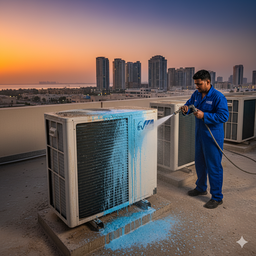
- Money Saving Tip: If your roof compressor is covered in dust (common in JVC due to construction), it cannot release heat. This causes the compressor to run 24/7 without tripping off, leading to massive DEWA spikes.
The “Hot Upstairs” Syndrome: A JVC Townhouse Special
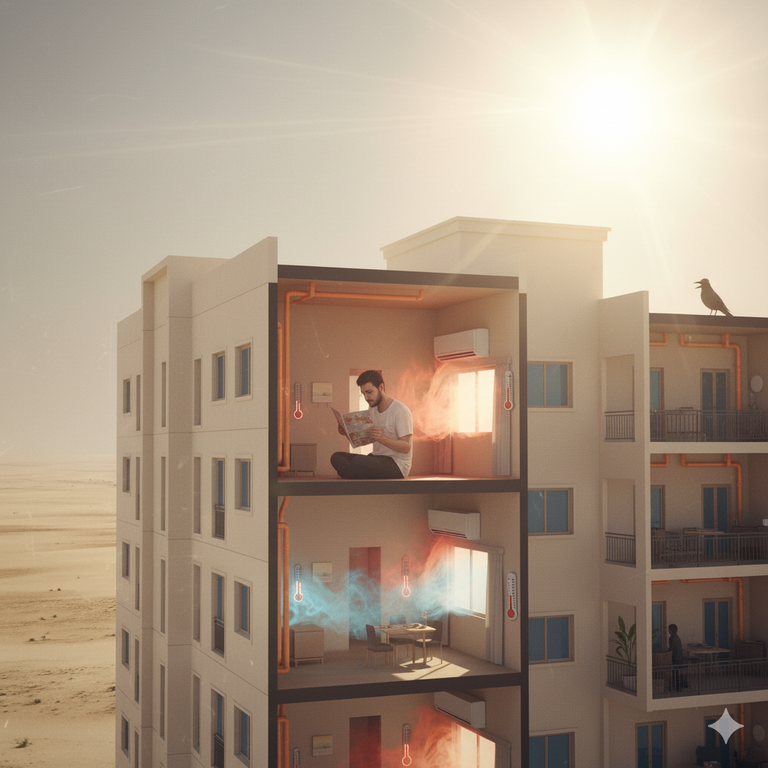
A common complaint from residents in Nakheel Townhouses and other G+1 or G+2 units is that the ground floor is freezing while the bedrooms upstairs remain warm.
This isn’t always a broken AC; it is often a physics problem exacerbated by maintenance issues.
Why it happens:
- Heat Rises: Naturally, the hot air from your living room floats up the stairwell.
- Roof Heat: The sun beats down on your roof all day, radiating heat directly into the upper ductwork.
- The “Stack Effect”: If your roof insulation is poor, your home acts like a chimney, sucking hot air in from the top.
How to fix it (Without moving house):
- Check the Dampers: Many JVC townhouses have “dampers” (valves) in the ductwork that control airflow. Often, these are stuck in a partially closed position from the day the house was built. A technician can manually balance these to force more air upstairs.
- Return Air Blockage: In many townhouses, furniture is placed in front of the “return air” grille (the vent that sucks air in). If the AC can’t suck air in, it can’t blow cold air out. Ensure your upstairs return vents are completely unobstructed.
- Thermostat Placement: If your thermostat is in the hallway (which is usually cooler), it thinks the job is done and turns off the AC, even if the bedrooms are hot. We often recommend upgrading to a thermostat with remote room sensors.
The Construction Dust Factor: The “JVC Filter Rule”
JVC is still developing. New projects near Elitz or Circle Mall mean the air is saturated with construction dust, cement particles, and sand.
Standard advice in Dubai is to clean filters every 3-4 months. In JVC, this rule does not apply.
If you live near an active construction zone (which is most of JVC), you need to clean your mesh filters every 4 weeks.
- The Impact: A layer of construction dust on your filter acts like a winter blanket. It suffocates your AC.
- The Cost: A clogged filter can reduce AC efficiency by 15%, meaning you are paying 15% more on your DEWA bill for less cooling.
- The Health Risk: Construction dust often contains silica and other fine particulates. If your filter is full, this dust begins to bypass the filter and accumulate in your ducts, eventually blowing out into your bedroom air.
5 Steps to Reduce Your DEWA Bill in JVC
You cannot change the DEWA tariff, but you can change how much power your AC draws.
1. The “24 Degree” Sweet Spot
Set your thermostat to 24°C. For every degree you lower it below 24°C, your energy consumption jumps by roughly 5-7%. If you set it to 20°C, your compressor may never turn off during a July afternoon.
2. Smart Thermostat Upgrades
Many JVC townhouses come with older, mechanical Honeywell thermostats. Replacing these with a smart thermostat (like Nest or Ecobee) can save you roughly 10-15% annually.
- Note: Many JVC homes require a “C-Wire” adapter for smart thermostats. Ask a professional before buying one off Amazon.
3. Deep Clean the Coils (Once a Year)
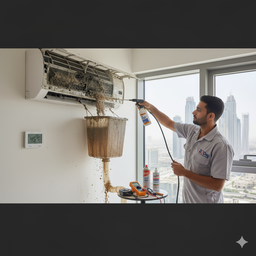
Cleaning the filters is something you can do. Cleaning the coils is for professionals. The evaporator coil is inside your AC unit. If it gets coated in the fine dust common in JVC, it can no longer absorb heat efficiently.
- The test: If you put your hand near the vent and the air feels “cool” but not “cold,” your coils are likely dirty.
4. Seal the Windows
Go to your windows and run your hand along the frame. Do you feel a draft? Many villas in JVC settle over time, creating small gaps in window frames.
- The fix: clear silicone sealant costs AED 20 at a hardware store. Sealing these gaps prevents your precious cold air from leaking out into the street.
5. Fan “Auto” vs. “On”
Check your thermostat fan setting. It should almost always be on “Auto.”
- Auto: The fan stops when the room is cool.
- On: The fan runs 24/7, even when the compressor is off. This not only wastes electricity but also pumps humidity back into your room, making it feel muggy.
Your JVC Maintenance Checklist
To keep your townhouse cool and your bills low, follow this schedule:
Monthly (DIY):
- [ ] Wash mesh filters with lukewarm water (shower pressure is fine).
- [ ] Check thermostat settings (Ensure it is on “Cool” and “Auto”).
- [ ] Listen for strange vibrations (common in roof units after high winds).
Quarterly:
- [ ] Inspect the outdoor unit (if accessible). Ensure no construction debris or plastic bags are blocking the fan.
- [ ] Check drain lines. Pour a cup of water mixed with vinegar down the drain line to prevent algae buildup (the #1 cause of ceiling leaks in JVC).
Annually (Professional Service):
- [ ] Deep clean Evaporator and Condenser coils.
- [ ] Check refrigerant gas levels (Gas does not “run out”—if it’s low, you have a leak).
- [ ] Tighten electrical connections (loose wires cause fires).
- [ ] Flush drain trays with pressure.
Is Your JVC Townhouse Not Cooling Properly?
If you are tired of sweating in your upstairs bedroom or dreading the arrival of your DEWA bill, it might be time for a professional assessment.
We specialize in JVC properties—we know the layouts, we know the common faults in Nakheel and private developer builds, and we know how to handle the dust.
We offer a comprehensive “JVC Summer-Ready” Inspection. We don’t just clean filters; we optimize your airflow to ensure your money is spent on cooling your family, not the attic.
Leave a Reply